This Weird Renault EV Just Set a Wild Electric Range Record
Range anxiety is (still) real
Apart from the recent dissolution of the Federal EV tax credit back at the end of September and the loosening of corporate average fuel economy rules, one persistent factor that has kept many American buyers out of battery-electric vehicles is range anxiety: an issue exacerbated by the lack of public EV charging infrastructure throughout the country.
One response that automakers such as Ford, Stellantis, and Volkswagen‘s upcoming Scout brand are developing as a potential solution is a new category of electric vehicles known as EREVs, or Extended-Range Electric Vehicles. These cars feature a small gasoline engine that serves as an onboard power plant, activating when the battery needs to be charged.
However, French automaker Renault hasn’t entirely given up on trying to unlock more range out of its EVs. Its latest creation, the Filante Record 2025, is a new electric concept car that just proved that electric vehicles can (literally) go the distance on a normal-sized battery alone when engineers are given free rein to experiment.
Renault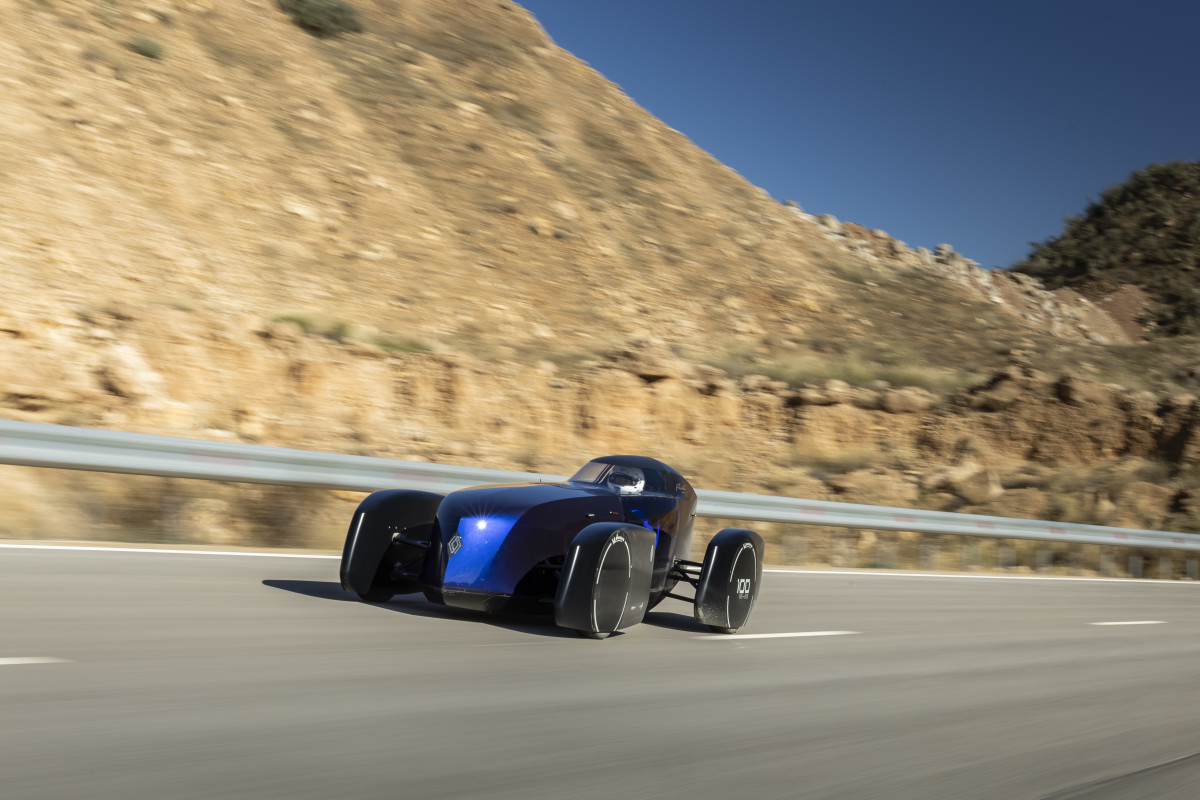
Over 626 miles on a single charge
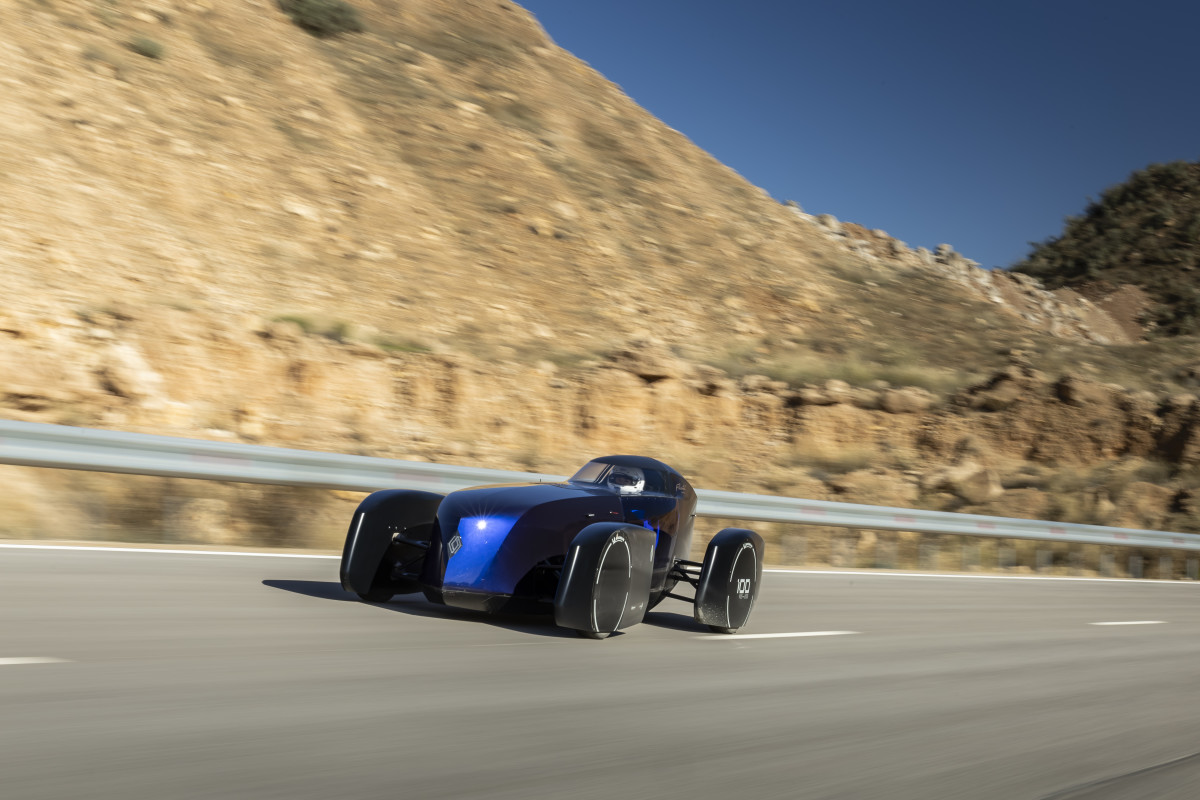
In a statement released by Renault, the French automaker announced that on December 18, 2025, this sinister-looking, art deco-inspired machine drove 1,008 kilometers (~626 miles) in under 10 hours without stopping to recharge at a test track in Morocco.
Renault says that the record in itself was a challenge that it undertook at the beginning of the year: to drive an EV more than 1,000 kilometers without stopping to charge using a car equipped with off-the-shelf components in its inventory and going at speeds that mimic realistic highway speeds.
After inclement weather blew off its first attempt in October, the engineers at Renault pushed the Filante to cover over 1,000 km at an average speed of 102 km/h (~63 mph). Best of all, it did all this with an 87 kWh battery, the exact same size battery that you’d find in Renault’s Scenic E-Tech electric SUV, a consumer-grade EV that is WLTP rated for 381 miles. The automaker states that after nearly 10 hours of driving, the vehicle consumed just 7.8 kWh per 100 km and still had 11% battery left, enough for another 120 kilometers (~74.56 miles) at highway speeds.
Renault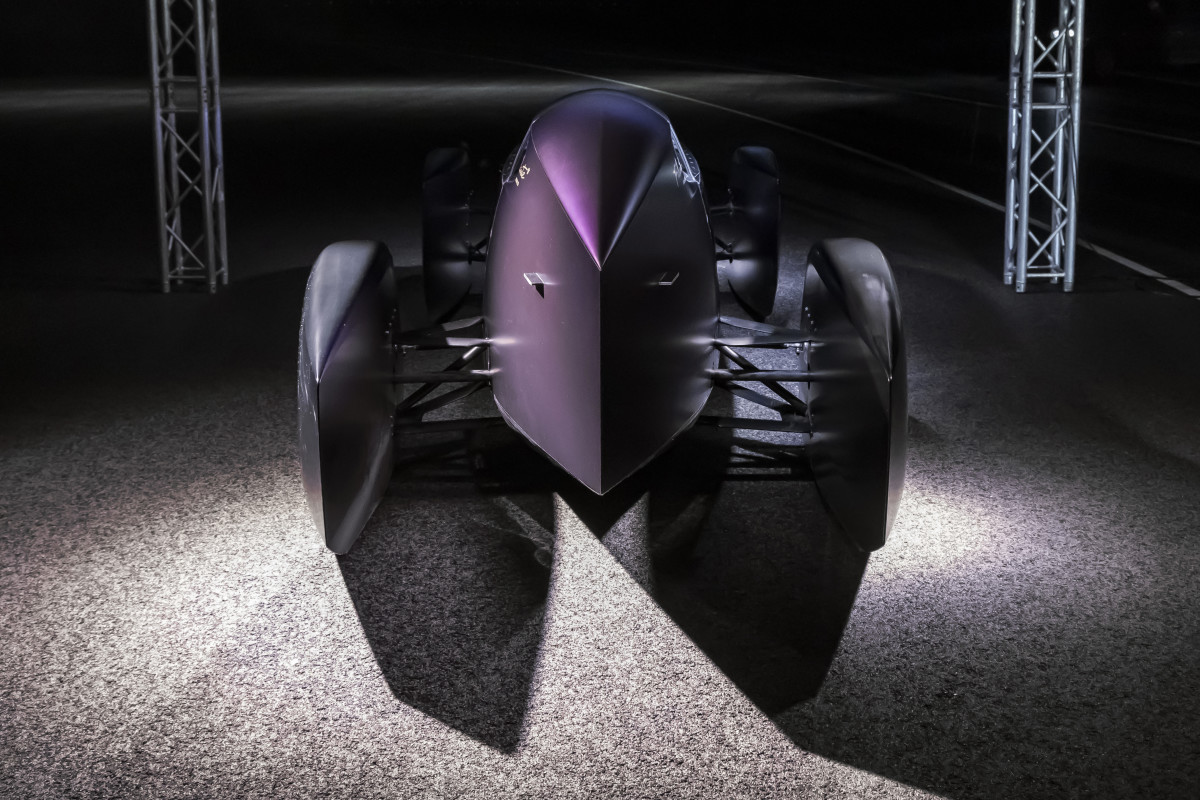
The secret sauce
Although Renault’s Filante Record 2025 is a concept car, it is a rolling laboratory for proven efficiency. The vehicle itself weighs just 1,000 kg (~2,200 lbs), or approximately the same weight as a new Mazda MX-5 Miata, which is remarkably light for a modern car. To keep the weight down, the Filante is made of exotic materials reserved for high-caliber sports cars, including carbon fiber, aluminum alloys, and even 3D-printed components made of a super-light material called Scalmalloy.
The Filante also features an ultraviolet blue paint job that acts as a tribute to the 1925 40 CV and 1956 Étoile Filante record cars, a fighter-jet-inspired cockpit bubble, steer-by-wire, brake-by-wire, as well as a custom set of Michelin tires that have low rolling resistance and enhance the vehicle’s aerodynamics.
While the Filante looks like it is straight out of a cyberpunk fantasy video game or movie, it isn’t just for show; the vehicle’s design is a masterclass in aerodynamics presented as a gorgeous tribute to Renault’s record-breaking past. Renault aerodynamics engineer Jocelyn Mérigeault said that the Filante’s shape was developed after extensive testing in the wind tunnel. The team redesigned the wheel fairings to mount directly onto the wheels, improving airflow around the mechanical components and optimizing the air intakes to reduce the car’s drag coefficient to about 0.30.
“Filante was inherently aerodynamic from the outset,” in a statement. “What we did was fine-tune it to unlock its full potential and enable it to meet our performance targets.”
Renault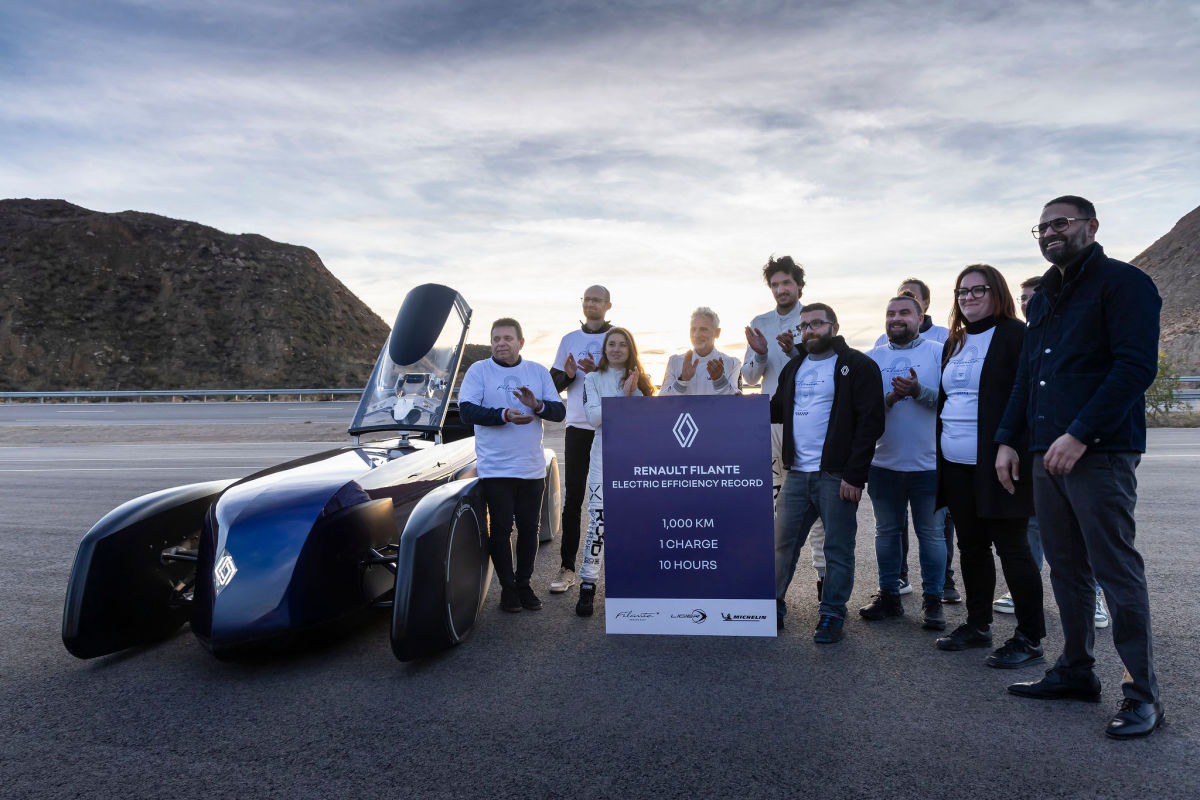
Record-breaking drive “felt like running a marathon,” said the test driver
The task of achieving the efficiency record was given to three Renault test drivers and engineers. Laurent Hurgon, a Renault development driver, went first and drove for 3 hours and 20 minutes before handing it over to Constance Léraud-Reyser, a chassis control systems engineer who described his four-hour shift behind the wheel as taxing.
“Four hours at the wheel felt long, but the adrenaline and the music in my ears helped me push through,” he said. “[…] With the heat and the thirst, it really felt like running a marathon, but the personal challenge was met, as I managed to drive for four hours, far longer than planned.”
However, Arthur Ferrière, the chassis tuning engineer, brought the vehicle through the home stretch, finishing the 1,008-kilometer run after 9 hours and 52 minutes.
Final thoughts
While the Filante Record 2025 isn’t a production car you can buy tomorrow, this wild experiment proves that massive range improvements are possible with existing battery technology when you optimize everything else. Surely, the next EVs won’t exactly look as cool and sinister as the Filante, but the lessons learned are sure to help aid designers of future EVs bring the same sort of efficiency innovation to regular customers.
Although the future of EVs is at a crossroads in the United States, it is nice to see that real innovation is happening overseas. Hopefully, designers could learn a thing or two and apply the same sort of discipline and principles for the next-generation machines sold here in the States.