The Bizarre BMW Diesel Experiment That Put Ford Thunderbirds in Munich
The idea sounds absurd: diesel-powered Ford Thunderbirds roaming the streets of Munich under BMW supervision. But at a certain point in the 1970s, that unlikely premise apparently became reality. Even more unlikely, the responsible party is none other than BMW Motorsport — perhaps the last organization you would relate to diesel power. Depending on how you look at it, the series of unlikely pairings had all the eccentricities of greatness or markings of a flop. But either way, it’s an origin story explaining how a BMW diesel engine found its way into an American luxury coupe.
An American in Munich
You might not know the name Burkhard Goeschal. But he’s at least part of the reason for a fleet of Ford Thunderbirds descending on Munich sometime in the 1970s. According to him, Ford contracted BMW Motorsport to “test and validate Steyr-sourced diesel engines.” Logically, this meant BMW Motorsport needed to install diesel engines in vehicles with Ford badges. Apparently, Motorsport was in no condition financially to turn away the request — albeit seemingly very far from what the Motorsport division is best at. The agreement led to a flock of Ford Thunderbirds cropping up in Munich as test cars.
But it probably wasn’t the wild and winged 1950s and 1960s era Thunderbirds cruising through the streets of Munich. Remember that Goeschal didn’t start at BMW until January 1978. That places the Ford Thunderbird at least in its seventh generation. Unlike the cars preceding it, the seventh-gen Thunderbird was smaller and prioritized fuel efficiency. Of course, these characteristics were total byproducts of the ongoing oil crisis. However, the test cars were almost certainly early or even pre-production ninth generation models, for a very good, ostensibly unrelated reason: the Lincoln Mark VII.
The Thunderbird Diesel: Where It Ended Up

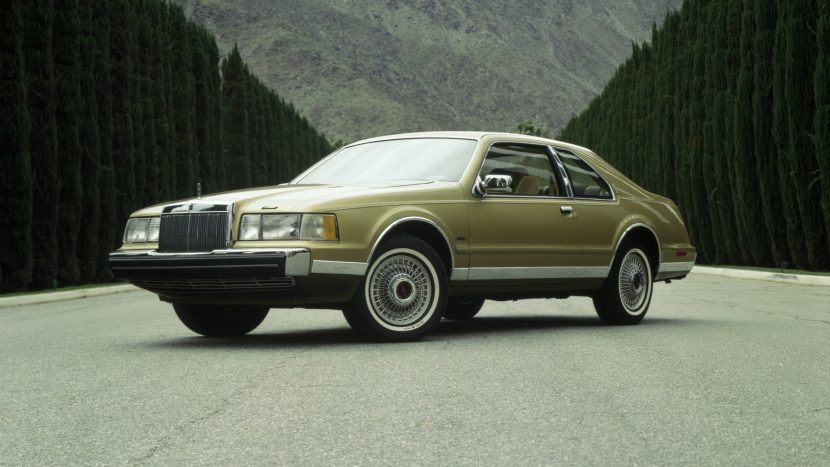
The Lincoln Mark VII debuted as the Lincoln Continental Mark VII in 1983. The Mark VII came with only two engine choices: a 5.0-liter V8 making up to 225 horsepower and a BMW M21 diesel engine. Underpinning the Mark VII was the same Ford Fox platform behind the contemporary Mustang, Mercury Cougar, and yes — the ninth-gen Ford Thunderbird. While the Ford Thunderbird never got a diesel engine, roughly 2,300 Lincoln Mark VIIs shipped with the diesel. With BMW power and a ZF-sourced automatic — rather than the four-speed Ford trans backing the 5.0-liter — it’s almost certain the Thunderbirds in Munich later became the Lincoln Mark VII.
Furthermore, describing the M21 as a “Steyr diesel” also makes sense. In the 1970s, BMW set out to develop an engine that combined strong performance with improved fuel economy. As you might have guessed, another direct response to the oil crisis. Development formally began in 1975, with team of BMW engineers using the M20 gasoline engine as a foundation. By the time the engine reached production, its designation had been finalized as the M21. From the outset, BMW intended the Steyr engine plant to be the exclusive production facility for the new diesel. The plant was established as a joint venture with Steyr-Daimler-Puch in 1978, before BMW assumed full control in February 1982. Early production at Steyr initially focused on six-cylinder gasoline engines, with diesel manufacturing ramping up soon after.
The BMW-Ford Diesel Loop Closes
In 1983, Ford announced plans to purchase as many as 190,000 BMW turbodiesel engines over several years. However, the rapid collapse of the American diesel market in the early 1980s curtailed those ambitions. The Lincoln Mark VII is the only thing to show for it 40 years later. Thanks to Steve Saxty for the source quote from Dr. Goeschal. While you won’t find this story in his excellent BMW books, we still recommend you pick up a set for yourself.
First published by https://www.bmwblog.com